
Medically reviewed by Dr. Chase Atwood, DACVS — board-certified veterinary surgeon. Last reviewed: May 2026
Quick Facts: TTA vs TPLO
- TPLO is the procedure of choice for the vast majority of dogs with a torn cranial cruciate ligament (the dog version of an ACL).
- TPLO has over 30 years of peer-reviewed outcome data showing consistent return-to-function across dogs of every size at short and long-term time points.
- TTA was developed as an alternative in the early 2000s. Its use has narrowed as long-term TPLO data has accumulated.
- Most board-certified veterinary surgeons today perform TPLO almost exclusively, with TTA reserved for a very small subset of cases.
- Recovery for either procedure runs about 8 to 16 weeks before your dog is back to full activity.
TPLO is the modern standard for surgical repair of a torn cranial cruciate ligament (the dog version of an ACL) in dogs. Most board-certified veterinary surgeons today recommend TPLO for almost every case, based on decades of outcome data and broad applicability across dog sizes and activity levels. Furthermore, in the hands of an experienced surgeon, the TPLO procedure has a very high success rate and a very low complication rate. In addition, it can be used on dogs ranging from 5 pounds to 200 pounds. It can also be used effectively in dogs with a wide variety of tibial plateau slopes (the top angle of the tibia that causes the forward movement during ACL tears).
If your dog has just been diagnosed and you’re researching surgical options, you’ll see both TPLO and TTA discussed online. TTA still appears in older articles and pet-owner forums because it was popular in the early-to-mid 2000s. Its role today is much narrower. This guide explains what each procedure actually does, how the published research compares them, and why TPLO has become the procedure most surgeons recommend.
What is the Difference Between TPLO and TTA?
TPLO and TTA both stabilize a knee with a torn cranial cruciate ligament, but they do so in very different ways. The TPLO aims to flatten the top of the tibia to prevent the forward movement that occurs when the ACL is torn. It does not change what’s on the joint surface (cartilage, meniscus, etc), just the orientation of it. When the ligament tears, the knee becomes unstable. The thigh bone (femur) pushes the shin bone (tibia) forward every time your dog puts weight on the leg. That movement causes instability, pain, swelling, and ongoing damage to the cartilage cushion inside the knee, leading to osteoarthritis.
The TTA procedure moves the insertion of the patellar tendon forward and is basically asking the quadriceps (big thigh muscle) to do the work of the ACL. The goal is to get the patellar tendon at a 90-degree angle to the top of the tibia. It is generally best used in dogs with a lower tibial plateau slope and adequate musculature.
TPLO and TTA each reshape part of the knee to make it stable. Once the knee becomes stable again, your dog can use the leg normally.
The difference is which part of the knee gets reshaped:
- TPLO changes the angle of the top of the shin bone.
- TTA moves the front of the shin bone forward to change the angle of the kneecap tendon relative to the tibia.
The end goal is the same. The methods differ in how much bone is moved, how the implants stabilize it, and how the procedure is performed across different dog anatomies. Healing times are often longer with the TTA compared to TPLO, depending on which TTA method is used.
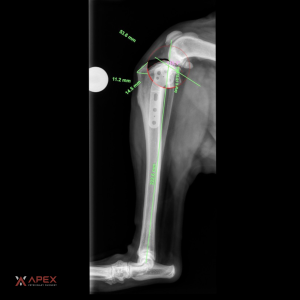
TPLO planning radiograph showing pre-surgical measurements and tibial plateau angle in a dog’s knee.
How Does TPLO Work?
TPLO stands for Tibial Plateau Leveling Osteotomy. In plain terms: the surgeon makes a curved cut at the top of the shin bone, rotates that piece to flatten its natural slope, and secures it with a metal plate (stainless steel or titanium).
The flatter angle takes the forward “slide” out of the knee. That’s the motion the torn ligament used to prevent.
- TPLO has over 30 years of peer-reviewed outcome data behind it.
- It works reliably for dogs across the full size range, from small breeds under 10 pounds to giant breeds over 150.
- Surgery typically takes 30 to 45 minutes per knee.
- The plate stays in your dog’s leg permanently and rarely needs to be removed.
- Most dogs return to near-normal function within six months of surgery, with 90 to 95 percent reaching full activity by 12 to 16 weeks.
- Should the plate need to be removed (under 5% of cases), the process is simple with TPLO compared to TTA.
How Does TTA work?
TTA stands for Tibial Tuberosity Advancement. The surgeon moves the top of the shin bone (the spot where the kneecap tendon attaches) forward by a small amount, then locks it in place with a titanium cage, plate, and screws. Other methods can use a biocompatible wedge.
That small shift changes the angle of the kneecap tendon’s pull. The forward slide in the knee stops during weight bearing as a result.
- TTA was developed in the early 2000s as an arguably less invasive alternative to TPLO (both cut bone).
- It performs best in dogs with a lower-than-average tibial slope.
- Published success rates range from 85 to 93 percent, with higher rates of late complications in some long-term studies compared to TPLO.
- TTA’s use has narrowed over the past decade as TPLO data has accumulated and surgeon training has concentrated on the gold standard procedure.
What Does the Research Say About Long-term Outcomes?
Multiple peer-reviewed studies and meta-analyses have compared TPLO and TTA. The pattern in the literature is consistent:
- TPLO shows better long-term lameness scores and lower rates of meniscal injury after surgery.
- TPLO has lower rates of implant complications and revision surgery in long-term follow-up.
- TPLO produces more consistent outcomes across a wider range of dog sizes and anatomies.
TTA’s published outcome data are comparable to TPLO in dogs with the right tibial geometry. Fewer dogs fit those criteria than fit TPLO’s broader applicability, and fewer surgeons today maintain the high case volume needed to perform TTA at the highest skill level.
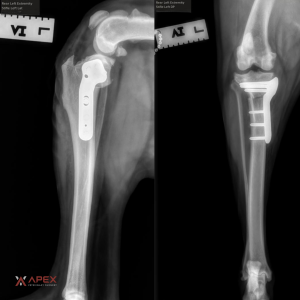
Combined post-operative TPLO radiographs from a single case at Apex Veterinary Surgery, showing the implant in side view and front-to-back view. Both confirm proper plate position and bone alignment after surgery.
How Does Recovery Compare?
Recovery is nearly identical for both surgeries:
- Weeks 1–2. Strict rest. Your dog is leashed every time they go outside, even for bathroom breaks. Cold packs on the knee and prescribed pain medication.
- Weeks 3–6. Short, controlled leash walks. The walks get longer week by week.
- Weeks 7–10. Recheck X-rays to confirm the bone is healing. If everything looks good, light jogging and physical therapy can begin.
- Weeks 10–12+. Off-leash activity is allowed once the bone has fully healed.
The full timeline from surgery to full activity is about 8 to 12 weeks for both procedures.
The most important thing during recovery is sticking to the activity restrictions for the first six weeks. Dogs who are allowed to do too much too soon account for most of the late complications, and that’s true regardless of which surgery they had.
Which Surgery is Right for My Dog?
For most dogs with a torn cranial cruciate ligament, the answer is TPLO. The reasons:
- TPLO has the strongest evidence base. Over 30 years of peer-reviewed data show consistent return-to-function across dog sizes, activity levels, and tibial anatomies.
- TPLO works reliably for nearly every dog. From small breeds under 10 pounds to giant working dogs, TPLO produces dependable outcomes. TTA’s published data narrows to dogs with specific tibial geometry, typically mid-to-large breeds with a steeper-than-average slope.
- Most board-certified veterinary surgeons today perform TPLO at high volume. Surgeon experience is one of the strongest predictors of long-term outcome. A surgeon who performs hundreds of TPLOs each year and only the occasional TTA will deliver better outcomes with TPLO. Most DACVS surgeons today fit that profile because the field has converged on TPLO as the procedure of choice.
TTA still has a role in a small subset of cases. The decision to recommend it is made by a board-certified veterinary surgeon based on pre-surgical X-rays, your dog’s anatomy, and the surgeon’s own case volume with the procedure.
How Does Apex Veterinary Surgery Choose Between TPLO and TTA?
Apex Veterinary Surgery recommends TPLO for most cranial cruciate cases. The recommendation rests on long-term outcome data and our team’s high case volume with the procedure. Our board-certified veterinary surgeons (DACVS) perform TPLO at our Brentwood location in the Nashville metro and our Germantown location in the Memphis metro.
Every cranial cruciate case begins with a full orthopedic exam, pre-surgical X-rays to measure the knee angle, and a conversation with the family about the dog’s activity level and what recovery will look like at home. TPLO produces consistent results across dog sizes and activity levels, and our patients return to full function within the standard 8-week recovery window.
Every consult covers the surgical plan, the recovery timeline, and what to watch for after your dog comes home. You leave the appointment understanding exactly why a specific procedure was recommended for your dog.
Frequently Asked Questions
Why do most veterinary surgeons recommend TPLO over TTA?
TPLO has over 30 years of peer-reviewed outcome data, broader applicability across dog sizes, and better long-term lameness and complication scores in head-to-head comparisons. Most board-certified surgeons today have concentrated their training and case volume on TPLO, which makes the procedure even more reliable in their hands.
Is TTA cheaper than TPLO?
Pricing varies by region, surgeon, dog size, and hospital, but the difference between the two surgeries is usually small. The more useful question is which procedure gives your dog the best long-term outcome. For nearly every dog, that procedure is TPLO.
Can a torn cranial cruciate ligament heal on its own?
A torn CCL does not heal without surgery. Dogs managed without surgery typically develop progressive arthritis and additional knee damage over the following 6 to 18 months. Surgical stabilization stops the instability and slows the arthritis that follows the injury.
How long is the recovery for TPLO?
About 6 weeks of restricted activity, an X-ray around weeks 6 to 8 to confirm healing, then a gradual return to full activity by weeks 10 to 12. The timeline is similar for TTA.
Is TTA less invasive than TPLO?
Both procedures cut the bone to change the biomechanics of the knee. Proponents of the TTA argue that it is less invasive because there is less soft tissue disturbance to make the cut. Originally, this was true, as early TPLO surgeries removed the muscle from the inside and back part of the tibia. Most surgeons today only remove a little soft tissue from just the inside of the tibia, making the difference negligible. The recovery commitment, complication risk, and long-term function are not meaningfully different in favor of TTA. Most surgeons consider this label more cosmetic than clinically significant.
What if I read online that my dog should have a TTA?
TTA was a popular alternative in the early to mid-2000s, and a lot of older content online still presents it as an equal choice. Current research and surgical practice point to TPLO for nearly every case. The right call for your dog comes from a consult with a board-certified veterinary surgeon, not from a forum post or older article. Remember that the surgical outcome will depend largely on the surgeon’s expertise and experience.
Questions to ask your surgeon
- How many TPLO/TTAs have you done? How many on average per day or week?
- What are the most common complications, and what do you do to avoid them?
- How long does surgery take?
- What type of implants do you use?
- Do you have advanced training in other advanced orthopedic procedures, such as fractures?
- If my dog does encounter a complication, can you typically handle it, or will you refer me elsewhere?
Schedule a Consultation
Apex Veterinary Surgery evaluates and treats torn knee ligament cases at our Brentwood location in the Nashville metro and our Germantown location in the Memphis metro.

Dr. Chase Atwood is a board-certified veterinary surgeon (DACVS) practicing at Apex Veterinary Surgery’s Brentwood office in the Nashville metro area. He earned his undergraduate degree in Wildlife with an emphasis in Pre-Veterinary Medicine and his Doctor of Veterinary Medicine from Mississippi State University, completing the DVM in 2010. He then completed a small animal rotating internship followed by a three-year surgical residency at Memphis Veterinary Specialists, where he performed a wide range of specialty surgical procedures and helped train fellow residents and interns. He became a Diplomate of the American College of Veterinary Surgeons in 2015.
Selected publications:
– Effects of incision closure method on infection prevalence following tibial plateau leveling osteotomy in dogs, The Canadian Veterinary Journal, 2015. https://pmc.ncbi.nlm.nih.gov/articles/PMC4357910/
Medically reviews surgical and orthopedic content on the Apex Veterinary Surgery website.